
Health & Fitness · iOS
Headspace: Sleep & Meditation
by Headspace Inc.

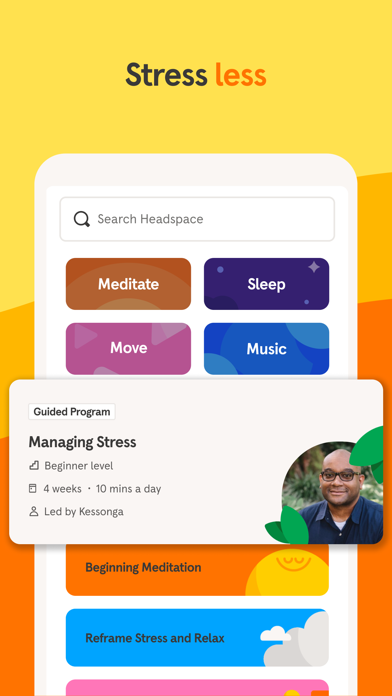


Launched in 2012 and still actively updated, Headspace takes a curriculum-first philosophy that sets it apart from library-style rivals. Numbered courses teach meditation as a transferable skill, narrated in the warm, slightly playful voice the brand made famous. Sleepcasts, focus music, an AI companion called Ebb, and access to licensed therapists round out an app that is clearly reaching toward full mental-health platform status, for better and for worse.
Teaching meditation better than volume of content
Headspace's defining strength is pedagogy rather than content volume. The Basics courses build technique step by step, supported by charming animations that demystify what meditation actually is before asking you to practice it. That sequenced, hand-held structure makes it the most approachable on-ramp in the category for skeptics and absolute beginners alike. Beyond the core curriculum, the app now covers sleepcasts, focus soundscapes, a conversational AI companion called Ebb, and pathways to licensed therapists and coaches. Each of those additions works reasonably well on its own terms, though the combination can feel like several apps sharing one home screen. The teaching quality at the foundation remains best-in-class.
Heavy install size, stable performance at scale
With a 477 MB install, Headspace is among the heavier apps in the Health and Fitness category, and users on storage-constrained devices will feel that immediately. Once installed, the app benefits from a long update history and a near-974,000-rating user base that has consistently pushed the score to 4.84, signals that suggest stable, well-tested builds rather than a buggy or neglected product. Streaming audio for sleepcasts and focus music depends on a reliable connection, and offline access is gated behind the premium subscription. Day-to-day navigation is smooth, and session loading feels prompt under normal network conditions, though we cannot quote specific performance figures beyond what those real-world signals imply.
Premium pricing justified for committed learners
The free tier offers a genuine taste of the curriculum but gates most content behind a subscription. Headspace has historically sat at the higher end of meditation app pricing, and the expansion into therapy and coaching adds further optional costs on top of the base membership. For beginners who will genuinely work through the structured courses, the value proposition is strong. Casual users who only want occasional breathing exercises may find the price harder to justify. The broad toolkit including sleep, focus, AI, and therapy access does mean you are potentially replacing several separate apps, which helps offset the cost if you actually use those features.
Health data collection requires careful review
Headspace collects health and wellness data, usage patterns, and account information as part of its personalization features. The specifics of what is collected, how it is shared, and what is linked to your identity are detailed in the App Store privacy nutrition label, which is the authoritative source to consult before subscribing. Given that the app now connects to licensed therapists and an AI companion, users should review those data practices with particular care. The content rating of 12-plus suggests Apple found no mature-content concerns, but privacy diligence around sensitive mental-health data is always warranted regardless of category norms.
Thoughtful design complicated by feature expansion
Headspace has long set a visual standard in the wellness category. The illustrated characters, soft color palette, and animated explainers feel cohesive and intentional rather than decorative, and they serve a genuine teaching purpose by making abstract concepts concrete. Onboarding is among the best in class, guiding new users to relevant content without overwhelming them. The expanding feature set does add navigational complexity, and some users report that finding specific content requires more tapping than it once did. Standard iOS accessibility features apply, and the app supports Dynamic Type for text scaling, though users with specific assistive-technology needs should verify screen-reader compatibility against their own setup.
Fourteen years of active development and iteration
A July 2026 update on version 8.23.0, combined with a release history stretching back to February 2012, paints a picture of consistent, long-term investment. Fourteen years of updates and a rating count approaching one million suggest a development team that responds to user feedback and platform changes rather than coasting on an established reputation. The addition of Ebb and the therapy pathways in recent versions confirms that Headspace is still making meaningful product bets rather than simply patching bugs. That ongoing ambition is a genuine strength, even if it is also the source of the scope-creep concerns that more focused users will notice.
Pros
- Structured, numbered curriculum is the most beginner-friendly teaching approach in the category
- Warm narration and purpose-built animations make abstract meditation concepts genuinely accessible
- Broad toolkit spanning sleep, focus music, AI companion Ebb, and licensed therapy access
- Nearly 974,000 ratings averaging 4.84 reflect a stable, well-maintained build over 14 years
Cons
- 477 MB install is one of the heaviest in Health and Fitness, a real burden on storage-limited devices
- Expanding into therapy, coaching, and AI blurs the app's focus and stacks up additional costs
- Heavily guided, narrated style can feel patronizing to practitioners who have moved past the fundamentals
Related guides
Similar Health & Fitness apps


apptidal is independent and ad-supported. We earn no commission on installs and no company can pay for a better score. How we stay independent.