
Education · iOS
English Learning - AI LearniQ
by Laraun

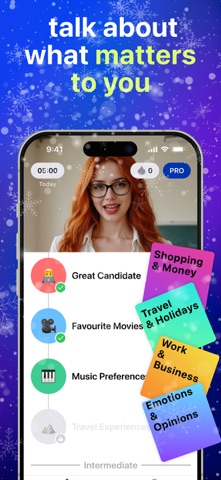


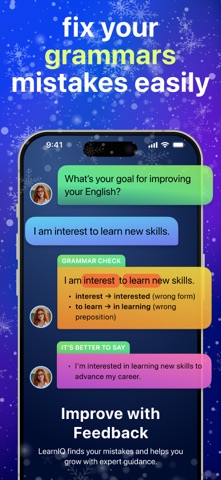

Launched in December 2024 and already earning 4.56 stars across 658 ratings, LearniQ from Laraun is a free AI-powered English tutor built around real-time pronunciation and grammar coaching. The 248 MB download is moderate by modern standards, and a March 2026 update confirms ongoing development. The conversational AI space is crowded, but execution here feels noticeably more tutor-like than most free alternatives at this price point.
Real-time feedback outpaces typical language drills
LearniQ centers its experience on AI-driven conversation practice with corrections delivered in the moment rather than after the fact. That real-time feedback loop is the app's clearest differentiator: instead of a simple right-or-wrong grade, the AI flags pronunciation and grammar issues as they occur, mimicking the rhythm of a live tutor more convincingly than most flashcard or multiple-choice rivals. Scenario-based dialogues give learners context that isolated drills cannot replicate. For anyone who rarely gets face-to-face speaking time, that immediacy is a meaningful advantage, and it likely explains why a still-modest reviewer pool has pushed the store rating to a strong 4.56. The core concept is well executed even if the feature set is still maturing.
Early release shows active iteration and stability
At 248 MB the install footprint is reasonable, sitting comfortably in the mid-range for AI-assisted education apps that bundle language models or voice-processing components. The March 2026 update on a December 2024 release points to a developer who is actively iterating rather than shipping and abandoning, which is a positive signal for stability. That said, version 1.1.5 is still an early release, and some rough edges in loading or session flow are plausible for an app this young. No offline capability has been confirmed, so learners in low-connectivity environments, commuters on spotty transit networks, for example, should factor that limitation into their expectations before relying on the app daily.
Free trial masks uncertain paywall structure
The free entry point removes any financial risk from a first look, which is genuinely valuable in a category where competing apps can charge upfront. The in-app purchase structure, however, almost certainly imposes a ceiling on the free experience, and Laraun has not publicly detailed exactly where that ceiling sits. Learners should treat the free tier as a trial rather than a complete product. If the AI conversation quality holds up under a subscription, the value proposition could be strong relative to scheduling a human tutor. Until the paywall depth is clearer, committing money warrants caution, particularly given the app's limited track record compared with more established rivals.
Microphone access necessary, privacy label unclear
Because LearniQ relies on voice input for pronunciation practice, microphone access is an expected and necessary permission. An AI-driven app of this type may also collect usage data, device identifiers, or audio samples to improve its models. The definitive source for what is actually collected and whether data is linked to your identity is the App Store privacy label on LearniQ's product page. Reviewers recommend checking that label before installing, paying particular attention to the data-linked-to-you and data-used-to-track-you sections. Laraun has not published a detailed public privacy policy summary, so the App Store label is the most reliable reference available.
Accessible design suits varied learners
A 4+ content rating signals that Laraun has kept the app free of mature material, making it suitable for younger learners as well as adults. Education apps in this category typically rely on clear typography, high-contrast lesson cards, and straightforward navigation, all of which support basic accessibility. Whether LearniQ fully supports Dynamic Type, VoiceOver, or other iOS accessibility features is not confirmed in public documentation. Learners who depend on those tools should test the free tier specifically for compatibility before committing. The conversational format is inherently more engaging than static drills, and the scenario-based structure gives the interface a purposeful, goal-oriented feel that should suit a wide range of learning styles.
Rapid update cycle signals ongoing development
The development timeline here is encouraging for an app this young. Releasing in December 2024 and shipping version 1.1.5 by March 2026 represents a meaningful update cadence for a solo or small-team developer. That pattern suggests Laraun is responding to user feedback rather than treating the launch as a finished product. The 658-rating sample is still relatively small, meaning the 4.56 average could shift as the user base grows, but the current trajectory is positive. Learners who adopt the app now are, in effect, joining during an active growth phase, which carries some risk of instability but also the benefit of features being added in response to community input.
Pros
- Real-time pronunciation and grammar corrections during live conversation practice create a genuinely tutor-like feedback rhythm
- Scenario-based AI dialogues simulate authentic exchanges rather than reducing practice to isolated drills
- Consistent update cadence, with a March 2026 release on a December 2024 launch, signals active developer commitment
- Free entry point lets learners evaluate the core AI experience before spending any money
Cons
- In-app purchases almost certainly gate the most useful content, but the exact paywall depth is not publicly disclosed
- No confirmed offline mode limits usefulness for learners in low-connectivity situations
- At version 1.1.5 with 658 ratings, the app is still early-stage and feature depth may lag more established competitors
Related guides
Similar Education apps


apptidal is independent and ad-supported. We earn no commission on installs and no company can pay for a better score. How we stay independent.