
Education · iOS
Hallo - Language Learning
by Hallo, Inc

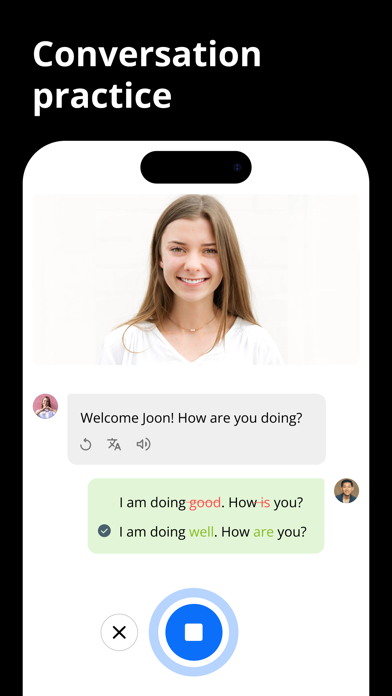


Launched in February 2019 and updated as recently as March 2025, Hallo focuses on AI-driven conversation rather than flashcards or grammar drills. The app spans more than 50 languages, installs at a reasonable 203 MB, and carries a 4.55 store rating across roughly 2,000 reviews. It is free to download, but the scope of in-app purchases remains opaque until you are already inside the experience.
AI conversation works smoothly but lacks grammar depth
Hallo's core proposition is simple: open the app, press a button, and be speaking a target language within seconds. That pitch holds up in practice better than many competitors manage. AI-driven dialogue removes the scheduling friction of booking a human tutor, and supporting more than 50 languages in a single install is genuinely broad for a speaking-focused product. Progress tracking and spoken feedback give learners something concrete to act on after each session, keeping the experience closer to a real lesson than a passive quiz. Where it falls short is depth: grammar explanations, reading, and writing are not the focus here, so learners who need a well-rounded curriculum will need supplementary tools.
Compact app with active updates and smooth performance
At 203 MB, Hallo is a compact install relative to the breadth of languages it covers, and the March 2025 update signals that the team is actively addressing bugs and performance issues rather than letting the product stagnate. Qualitatively, a conversation-first app lives or dies on response latency from its AI engine, and user reviews averaging 4.55 stars suggest most people find the experience smooth enough to return to. That said, roughly 2,000 total ratings since a 2019 launch is a modest volume, meaning edge-case languages may not have been stress-tested by a wide audience. Daily five-minute sessions are the intended rhythm, which suits mobile use but may feel limiting for learners chasing faster progress.
Free download hides subscription details worth testing first
Hallo is free to download, which lowers the barrier to trying it. The problem is that the App Store listing does not clearly spell out what in-app purchases unlock, and in conversation-focused apps the most valuable features, deeper AI dialogue, extended session lengths, or richer feedback, frequently sit behind a subscription. Before committing any money, we recommend launching the app on a free account and testing exactly how far the unpaid tier takes you. If the free experience feels like a demo rather than a functional tool, the subscription price needs to be weighed against well-established rivals like Duolingo or Babbel, which offer more transparent pricing tiers.
Microphone access required, privacy label review recommended
Because Hallo is a voice-driven app, microphone access is a core permission rather than an optional one. The app will also likely request identifiers for account creation and potentially usage-data collection to improve its AI models. We have not independently audited network traffic or data handling, and we would caution against assuming any specific finding. The most reliable source of truth is the App Store privacy label on Hallo's product page, which Apple requires developers to keep current. Before subscribing, reviewing that label for data linked to your identity and any third-party sharing disclosures is a worthwhile two-minute step.
Simple design excels but accessibility varies by feature
The interface is built around a single primary action, starting a conversation, which keeps the visual design uncluttered and onboarding quick. That simplicity is a genuine design strength for learners who want to practice without navigating menus. On accessibility, a microphone-dependent app presents inherent challenges for users with speech or hearing differences, and Hallo does not appear to offer a text-based fallback mode as a core feature. Standard iOS accessibility settings such as Dynamic Type and display zoom should function normally, but users who rely on VoiceOver for navigation should verify compatibility before committing to a subscription, as spoken-interaction apps vary in how thoroughly they implement screen-reader support.
Six year update cycle shows sustained development
Version 3.35.1 landing in March 2025 is an encouraging signal for a product that launched in February 2019. Reaching a version number in the mid-thirties over six years suggests a consistent release cadence rather than occasional bursts of activity. The 4+ content rating and broad language roster also indicate the team has continued expanding the product rather than simply keeping the lights on. The relatively small review count of around 2,000 is the one note of caution: it suggests the active user base is smaller than flagship competitors, which can affect how quickly the team receives signal on bugs or AI quality issues in less common languages.
Pros
- Conversation begins within seconds of launching a session, making daily practice genuinely frictionless
- Covers more than 50 languages in a single 203 MB install, one of the broader selections in its category
- AI availability eliminates scheduling barriers that come with human-tutor platforms
- Consistent update history through early 2025 confirms the product is actively maintained
Cons
- In-app purchase scope is not disclosed upfront, leaving the true free experience unclear until you are inside the app
- Roughly 2,000 total ratings since 2019 points to a limited community, which may affect AI tuning for less common languages
- No meaningful support for grammar, reading, or writing makes it a poor standalone choice for learners who need a full curriculum
Related guides
Similar Education apps


apptidal is independent and ad-supported. We earn no commission on installs and no company can pay for a better score. How we stay independent.