
Social · iOS
Make New Friends - NoName
by Sandratra Razafindralambo

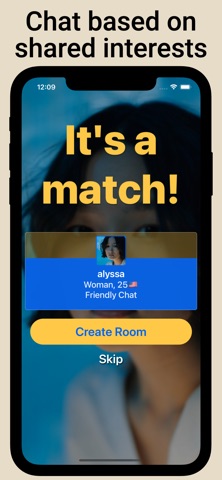


Released in July 2014 and still receiving updates, NoName lets users browse profiles and start one-on-one or group conversations outside the big-platform ecosystem. At just 34 MB it stays lean, and its safety toolkit is more considered than most indie apps manage. A store rating of 3.58 across 818 reviews, however, reflects a user base that is genuinely divided on whether the app delivers a satisfying social experience.
Safety features outpace community maturity
NoName centers on profile browsing and conversation, offering both one-on-one messaging and group chats with moderation controls. Where it distinguishes itself is in safety: a safe-blur feature automatically obscures unsolicited media, screenshot notifications alert you when someone captures your messages or photos, and a real-selfie requirement pushes back against fake profile pictures. Face ID and Touch ID passcode protection rounds out the toolkit. These are practical, well-considered additions that many larger and better-funded social apps still neglect. The group moderation angle also gives NoName a light community-building dimension that pure matchmaking apps lack. The concern is that the feature set itself hints at recurring bad behavior, and a 3.58 rating suggests the overall experience does not yet rise to meet the safety groundwork the developer has laid.
Lightweight app on current iOS
At 34 MB, NoName sits comfortably at the lighter end of the social-app category, which generally means faster installs and less storage pressure on older devices. A February 2026 update confirms the app is actively compiled against current iOS requirements, reducing the risk of crashes tied to outdated API calls. That said, performance in a social app is inseparable from community density, and the active user count is not disclosed. If the pool of online users is thin in your region, even a technically smooth app will feel like an empty room. The 818 ratings accumulated over roughly a decade also suggest modest overall adoption, which is worth weighing before investing time in a profile.
Free entry with purchase uncertainty
NoName is free to download, which removes any upfront barrier. The app does carry a 17-plus content rating, so it is positioned for adult audiences. Potential in-app purchases are listed in the app's store metadata, though the exact nature and pricing of those purchases should be confirmed before downloading, as they introduce cost uncertainty to what starts as a zero-cost proposition. For casual experimentation with a smaller social platform, the free entry point is reasonable. Users who find the community too sparse or the experience too rough may feel the time investment was not repaid, even without spending money.
Product safety design exceeds privacy clarity
NoName's in-app safety features, screenshot alerts, safe blur, and real-selfie verification, show that the developer has thought about user protection at the product level. For deeper privacy specifics, the App Store privacy nutrition label is the authoritative source and should be reviewed before installing. As a social app, NoName will almost certainly request access to your camera and photo library at minimum, and possibly contacts or location depending on feature use. Single-developer apps can carry higher uncertainty around data handling practices than apps backed by dedicated privacy and legal teams, so reading the privacy policy linked in the App Store listing is a worthwhile step.
Platform conventions present, accessibility unverified
The inclusion of Face ID and Touch ID support indicates at least some alignment with iOS platform conventions, which is a positive signal for overall design coherence. Beyond that, specific accessibility details, such as Dynamic Type support, VoiceOver compatibility, or contrast ratios, are not verifiable without hands-on testing. Social apps in this category vary widely in how well they implement Apple's accessibility frameworks. Prospective users who rely on assistive technologies should check recent user reviews for relevant mentions or contact the developer directly before committing. The app's longevity since 2014 suggests iterative refinement, but indie apps do not always prioritize accessibility investment alongside feature work.
Decade-long maintenance constrained by solo development
A February 2026 update on an app first released in July 2014 is genuinely impressive for a solo developer. That represents more than a decade of continued maintenance, which is rare in the indie social space where most competitors have quietly disappeared. Version 10.04 also implies a meaningful number of iterative releases over the years. The flip side is that single-developer maintenance means feature velocity, bug turnaround, and support responsiveness are all constrained by one person's bandwidth. The 3.58 rating has not improved dramatically despite ongoing updates, which suggests either that core experience issues are difficult to resolve at this scale or that the community dynamics are the limiting factor rather than the software itself.
Pros
- Safe blur and screenshot notifications are practical, well-implemented safety additions rarely found in indie social apps
- Real-selfie verification actively discourages fake or outdated profile photos
- Group chats with moderation tools add a community-building dimension beyond basic one-on-one messaging
- Over a decade of continuous maintenance, with a confirmed February 2026 update, shows genuine developer commitment
Cons
- A 3.58 store rating across 818 reviews points to persistent and widespread user dissatisfaction with the core experience
- Active user counts are undisclosed, making it impossible to gauge community density before investing time in a profile
- Single-developer structure limits support responsiveness, feature velocity, and the resources available to address community quality issues
Related guides
Similar Social apps


apptidal is independent and ad-supported. We earn no commission on installs and no company can pay for a better score. How we stay independent.