
Education · iOS
Pimsleur | Language Learning
by Simon & Schuster


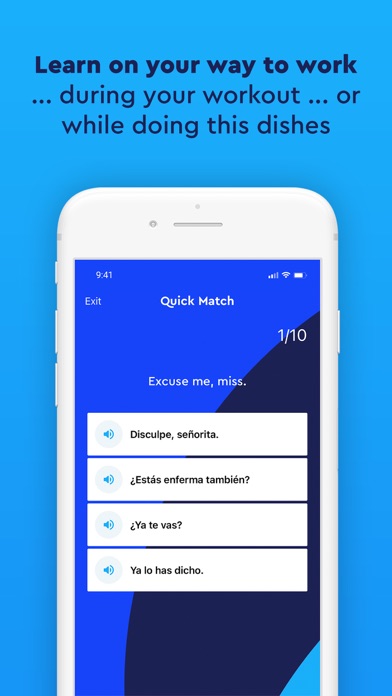

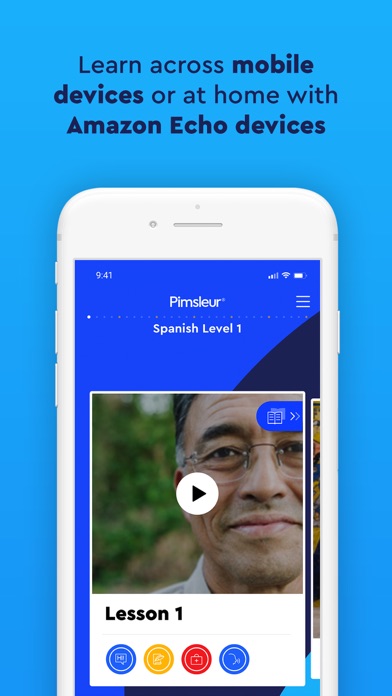

Built on a 50-year-old audio methodology, Pimsleur structures each lesson as a 30-minute prompted conversation rather than a gamified quiz. Graduated spaced repetition surfaces vocabulary just before you forget it, and a true hands-free mode means your eyes never need to leave the road. Reading and writing are present but clearly secondary. The result feels less like a mobile game and more like a patient, voice-driven tutor.
Audio-first method builds spoken fluency reliably
Pimsleur's core loop is deceptively simple: a native speaker prompts you in the target language, a pause invites your spoken response, and then the correct phrase is confirmed aloud. Graduated interval recall times each vocabulary review to land just before the brain would naturally drop it, which is a clinically grounded approach to retention. The method excels at pronunciation and conversational reflexes because the mouth is always involved, not just the eyes. Reading drills and digital flashcards have been added over successive updates, but they remain supplementary features rather than first-class citizens. For pure spoken fluency, the execution is polished and purposeful.
Compact app runs smoothly offline and on
At 117 MB the install is compact for a content-rich education app, and that restraint reflects a smart architectural choice: audio assets are streamed or downloaded on demand rather than bundled upfront. Offline lesson downloads work reliably, so a subway tunnel or a dead-data zone will not break a session mid-commute. With a 4.74 rating across roughly 28,000 iOS reviews, day-to-day stability is clearly strong. The hands-free mode is genuinely friction-free once configured, making it one of the few education apps that works as well on a treadmill as at a desk. Lesson load times feel snappy under normal conditions, though audio-heavy downloads on slower connections will take patience.
Premium pricing limits appeal to committed learners
The app is free to download, and a trial lesson is available without a payment commitment. Full access, however, requires a subscription that sits at the premium end of the language-learning market. Competitors like Duolingo offer substantial free tiers, so the value case for Pimsleur rests entirely on the quality of its audio-first method rather than breadth of free content. For learners preparing for an imminent trip or professionals who genuinely need spoken fluency fast, the price is defensible. Casual hobbyists or those who simply want to sample a new language may find the cost hard to justify given how little the free tier unlocks.
Corporate publisher handles privacy within standard framework
Pimsleur is published by Simon and Schuster, a major commercial publisher, so it operates within an established corporate privacy framework. The app carries a 4+ content rating on iOS, suggesting no sensitive content concerns. For a precise breakdown of data collected, data linked to you, and data used for tracking, the App Store privacy nutrition label on the app's product page is the authoritative source and should be reviewed before subscribing. Microphone access is required for the spoken-response feature and is a core part of the experience rather than an optional add-on. As with any subscription app, reviewing what account data is retained after cancellation is worth doing.
Minimal design serves low-vision users well
The interface is clean and deliberately minimal, which suits an audio-first product. Navigation is straightforward: lessons are sequenced, progress is visible, and the hands-free playback controls are large enough to tap without looking. Because the entire learning experience is voice-driven, the app is inherently more accessible to users with low vision than screen-heavy competitors. Dynamic Type and system-level accessibility settings on iOS should interact reasonably with the text elements present. The deliberate, unhurried pacing that some users find frustrating is actually an accessibility asset for learners who need time to process spoken language before responding.
Active development backed by major publisher
Version 7.8 was released on July 11, 2026, confirming that the development team is pushing updates in the current calendar year. The app has been on the App Store since August 2018, giving it a mature, stable codebase with nearly eight years of refinement behind it. A rating count of roughly 28,000 reviews on iOS alone indicates a large, engaged user base that provides meaningful feedback signals to the developer. Simon and Schuster's backing adds commercial continuity that smaller indie language apps cannot always guarantee. All of that points to a product that will continue to receive support and feature additions for the foreseeable future.
Pros
- Hands-free offline lessons integrate seamlessly into commutes, runs, and drives
- Audio-prompted speaking drills build genuine pronunciation confidence rather than passive recognition
- Graduated spaced repetition is well-timed and grounded in proven memory science
- Actively maintained with a July 2026 update and a large, stable user base
Cons
- Reading, writing, and grammar practice feel like afterthoughts rather than core features
- Full subscription pricing is steep compared to competitors offering generous free tiers
- The deliberate 30-minute lesson pace can frustrate learners who want faster, bite-sized progress
Related guides
Similar Education apps


apptidal is independent and ad-supported. We earn no commission on installs and no company can pay for a better score. How we stay independent.