
Utilities · iOS
Rain Alarm Live Weather Radar
by Carlos Aviles Software


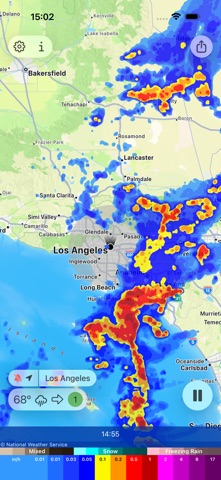

Released in October 2010 and still receiving updates as recently as June 2026, Rain Alarm Live Weather Radar skips the guesswork of percentage-based forecasts and watches live NOAA Doppler radar instead. When precipitation is actually moving toward your coordinates, a push notification fires. At just 32 MB and rated 4.64 across roughly 3,000 reviews, the app proves that a lean, focused approach can earn lasting user loyalty.
Animated radar alerts beat probability forecasts
The core mechanic is refreshingly direct: animated NOAA Doppler radar frames show where rain, snow, or ice is located right now and the direction it is traveling. Rather than presenting a 40 percent chance of rain that could mean almost anything, the app watches actual storm movement relative to your saved coordinates and fires a push alert when precipitation closes in. Coverage spans all 50 US states plus more than 30 countries, which is a meaningful footprint for a 32 MB utility. For a hiker, a construction worker, or a weekend athlete, that real-world situational awareness beats a probability model on most days.
Latency delays occasional but category-wide
Radar data carries inherent latency by nature, typically a few minutes behind real-time conditions, so users in fast-moving storm situations may occasionally find precipitation arriving slightly ahead of the alert. That is a category-wide limitation rather than a flaw unique to this app. The compact 32 MB install size suggests a lean codebase with minimal background overhead, and the consistent update cadence, most recently June 2026, points to an app that has been actively optimized over time. The relatively modest 3,000-review pool, modest for a 15-year-old utility, means edge-case performance reports are less plentiful than with major weather platforms, so reliability in unusual storm patterns is harder to verify from community feedback alone.
Free tier covers core alerts
The base app is free, which removes any barrier to trying the core radar-alert workflow. In-app purchases are present, but the App Store listing does not clearly itemize what features sit behind them, creating some uncertainty before you build a daily routine around the app. Given that the fundamental alert system appears accessible without payment, most casual users will likely find the free tier sufficient. Power users who want additional customization or extended radar history may encounter paywalls, so it is worth exploring the purchase options early rather than discovering limitations mid-storm.
Location access required, ad tracking likely
To deliver location-based radar alerts, Rain Alarm necessarily requests location access, which is expected and reasonable for this category. Beyond that, the specifics of data collection, sharing practices, and any advertising-related tracking are detailed in the App Store privacy nutrition label for this listing. We recommend reviewing that label directly before installing, paying particular attention to whether location data is linked to your identity or shared with third-party ad networks. As a free, ad-supported app from a single developer, some level of ad-related data collection is plausible and worth confirming.
Simple map design prioritizes usability
The interface prioritizes the radar map and alert controls above everything else, which aligns well with the app's single-purpose mission. Navigation is straightforward enough that new users can configure a location alert within minutes. The animated radar layer is visually clear, with color gradations representing precipitation intensity in a manner consistent with standard meteorological displays. Accessibility features such as VoiceOver compatibility are not independently verified here, but the relatively simple layout, few complex interactive elements and a map-centric design, suggests the app should present fewer barriers than feature-heavy weather dashboards. Users with accessibility needs should test the trial version before committing to any paid features.
Single developer maintains 15-year-old codebase
A release history stretching back to October 2010 combined with a version update dated June 2026 tells a clear story: this is not an abandoned utility coasting on old code. Continuous maintenance over more than 15 years from a single developer is genuinely uncommon and represents a meaningful trust signal. The current version is 5.2.2, indicating iterative refinement rather than stagnation. The tradeoff is that a solo developer operation has limited support bandwidth, so response times to bug reports or feature requests may lag behind those of larger weather app teams. Still, the longevity alone suggests the developer is committed to keeping the app functional on current iOS versions.
Pros
- Uses live NOAA Doppler radar movement rather than probability-based forecasts for alerts
- Covers all 50 US states and more than 30 countries in a 32 MB install
- Actively maintained for over 15 years with a confirmed June 2026 update
- Free base tier makes the core radar-alert workflow accessible with no upfront cost
Cons
- Radar data carries inherent latency that can delay alerts in fast-moving storm conditions
- In-app purchase scope is not clearly disclosed upfront, creating uncertainty about the free tier's limits
- Single-developer support structure limits bandwidth for bug fixes and user assistance
Related guides
Similar Utilities apps


apptidal is independent and ad-supported. We earn no commission on installs and no company can pay for a better score. How we stay independent.