
Utilities · iOS
Storm Radar: Weather Tracker
by The Weather Channel Interactive


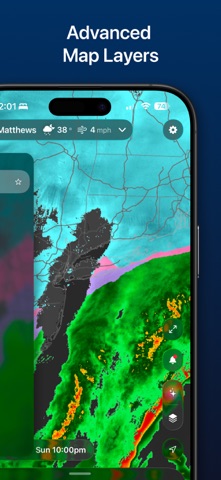


Released in 2017 and now at version 4.0.17, Storm Radar has matured into a multi-layer radar platform covering wind flow, lightning, hail probability, and tropical tracks alongside high-resolution single-site radar. The app carries an impressive 4.45-star average across roughly 118,000 ratings, signaling broad user satisfaction. At 272 MB the install is substantial, and the free tier comes with caveats worth understanding before downloading.
Layered radar visualization executes with genuine depth
Storm Radar's core proposition is layered radar visualization, and it executes that proposition with genuine depth. Switching between wind flow, lightning strikes, hail probability, and tropical track overlays feels purposeful rather than cosmetic. High-resolution single-site radar sharpens the picture of a nearby cell well beyond what a standard composite view offers. Future radar extending up to 72 hours for US users adds meaningful planning value, separating the app from lighter alternatives that only show current conditions. NOAA severe weather warnings and precipitation alerts round out a toolkit that functions as a credible safety resource, not merely a weather curiosity.
Heavy install size offset by recent updates
A 272 MB install is on the heavier end for a weather utility, which hints at the rendering demands of its high-resolution map layers. Update recency is a strong positive signal here: the app was refreshed as recently as June 2026, suggesting the development team actively addresses bugs and compatibility issues rather than letting the codebase stagnate. The 118,000 ratings averaging 4.45 stars across a multi-year install base indicate that performance complaints have not accumulated to a tipping point. That said, the app is inherently network-dependent, so users in low-signal or rural environments should expect degraded map tile loading rather than any meaningful offline fallback.
Free tier available but paywalls lack transparency
The base download is free, which makes the entry barrier low. However, the full scope of the free tier versus what sits behind in-app purchases is not transparently disclosed upfront, and that ambiguity is a genuine frustration. The AI Weather Assistant introduced in version 4.0 may be partly or fully paywalled, though specifics vary by region and subscription tier. For casual users, the free radar layers alone likely justify the install. Power users who want the full feature set should budget for a subscription and verify current pricing inside the App Store before committing, since subscription structures in weather apps shift frequently.
Location access necessary, usage data collection likely
Precise location access is functionally necessary for a radar app to center maps and deliver local alerts, so that permission request is expected and reasonable. Beyond location, The Weather Channel Interactive is a large commercial entity with advertising relationships, which means the app almost certainly collects usage and device data to support its ad-supported model. Rather than speculating on specifics, readers should consult the App Store privacy label directly under the app's listing, where Apple requires developers to disclose data types collected and whether they are linked to identity. Reviewing that label before installing is the most reliable way to make an informed decision.
Version 4.0 redesign improves navigation but overwhelms
The version 4.0 redesign brought a cleaner interface to what had previously been a dense, layer-heavy layout. Navigation between radar modes is more intuitive than earlier versions, though the sheer number of overlay options can still overwhelm users who simply want a quick rain check. The map-centric design suits larger iPhone screens well. On accessibility, the app's content rating of 4+ suggests nothing objectionable, but map-heavy applications can present challenges for users relying on VoiceOver, since radar visualizations are inherently visual. Apple's standard Dynamic Type and display accommodations should function for text elements, but the core radar canvas is unlikely to be fully screen-reader navigable.
Nearly a decade of consistent development from publisher
Active maintenance is one of Storm Radar's clearest strengths. The app launched in June 2017, has reached version 4.0.17, and received an update as recently as June 2026, reflecting nearly a decade of consistent development from a well-resourced publisher. The Weather Channel Interactive has the organizational backing to sustain long-term updates, which matters for a safety-adjacent utility where stale data pipelines or unpatched OS incompatibilities carry real consequences. The high rating volume across 118,000 reviews also suggests an engaged user base that would surface critical regressions quickly, providing an additional accountability signal.
Pros
- Multiple specialized map layers including hail probability, lightning strikes, wind flow, and tropical tracks provide genuine analytical depth
- High-resolution single-site radar delivers a noticeably sharper close-up view of nearby storm cells than composite alternatives
- Future radar extending up to 72 hours for US users supports real trip and safety planning beyond current conditions
- Consistently maintained with updates as recent as June 2026, backed by The Weather Channel's established data infrastructure
Cons
- At 272 MB the install footprint is large for a weather utility and may deter storage-conscious users
- Free-tier boundaries versus paywalled features are not clearly disclosed upfront, creating uncertainty about the true cost
- The AI Weather Assistant is too new in its current form to have an established track record, and its availability on the free tier is unclear
Related guides
Similar Utilities apps


apptidal is independent and ad-supported. We earn no commission on installs and no company can pay for a better score. How we stay independent.