
Social · iOS
Twiq - Social Chat
by Voletius Ltd

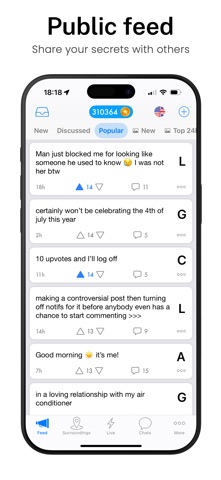


Twiq blends a public community feed with private one-on-one messaging, targeting users who want to meet people nearby or globally without the noise of major platforms. Launched in July 2020 by Voletius Ltd, it sits at 115 MB, requires no profile photo to sign up, and carries a 4.41 store rating across roughly 2,000 reviews. That score suggests a reasonably satisfied audience, though the rating count itself signals a still-niche footprint after five years.
Dual feeds and stranger games work well
Twiq runs two parallel tracks. A public feed lets users post, comment, and follow community conversations at a global scale, while the Surroundings list surfaces nearby accounts for more geographically grounded connections. Private chats go beyond plain text, supporting photos and voice memos, which meaningfully raises the ceiling on one-on-one conversation quality. The standout detail is a built-in Tic-Tac-Toe game that gives strangers a concrete, low-pressure activity to share, neatly sidestepping the cold-start awkwardness that plagues most stranger-chat apps. A Karma and leveling system layers a light game loop on top of social activity. The feature set is coherent and the dual-track design works better than it might sound on paper, though every feature ultimately depends on having enough active users nearby to make it feel alive.
Lean footprint and stable recent updates
At 115 MB, Twiq is notably lighter than most social apps in its category, which typically balloon well past 200 MB. That lean footprint suggests a focused codebase and should translate to reasonable launch times and modest storage impact on older devices. The app has received consistent updates through mid-2026, with version 11.0 representing meaningful ongoing development rather than a stagnant release. User reviews averaging 4.41 across 2,000 ratings point to a stable, largely crash-free experience for the people who do use it regularly. No specific performance benchmarks can be cited here, but the combination of a small install size, recent update cadence, and a positive rating distribution is a reasonable proxy for day-to-day reliability.
Free entry with unclear monetization details
Twiq is free to download with no stated upfront price, which removes any financial barrier to trying it. The app carries a 17-plus content rating, which aligns with the open stranger-chat premise rather than signaling aggressive monetization aimed at younger users. That said, the specifics of any in-app purchases or premium tiers are not clearly surfaced before download, which is a transparency gap worth noting. For users in dense urban areas where the Surroundings feature can actually populate, the free tier likely delivers genuine value. For users in smaller cities or rural regions where the local pool is thin, the value proposition weakens considerably regardless of price.
Photo-optional signup but check privacy label
The no-photo signup policy is a meaningful structural choice, reducing the personal data exposed during onboarding compared to apps that require a face or full profile from the start. The ability to end any conversation immediately also gives users a practical exit without social friction. Beyond these observable design decisions, the full picture of what data Twiq collects, retains, and shares sits in the App Store privacy label, which Apple requires developers to self-report. Prospective users should review that label directly before installing, paying particular attention to data linked to identity, location handling for the Surroundings feature, and any third-party analytics or advertising frameworks bundled in the app.
Familiar interface with creative game feature
Twiq's interface reflects a straightforward social-feed layout that most smartphone users will find familiar, with the dual feed-and-chat structure navigable without a steep learning curve. The no-photo signup flow keeps onboarding short. The built-in game feature is a creative UX choice that distinguishes the app visually and functionally from generic chat clones. Formal accessibility features such as Dynamic Type support, VoiceOver compatibility, and sufficient color contrast are not independently verifiable here without hands-on testing, but iOS developers targeting a broad audience are subject to Apple's Human Interface Guidelines, which set a baseline. Users with specific accessibility needs should test the app directly or consult community reviews that address those requirements.
Active development hindered by small user base
Version 11.0, updated in June 2026, confirms that Voletius Ltd is still actively investing in the product more than five years after its July 2020 launch. Reaching a double-digit major version number indicates a sustained development cycle rather than a one-and-done release. The consistent rating volume, while modest at around 2,000 reviews, has held a 4.41 average, suggesting that users who do engage with updates are not reporting a degraded experience over time. The main maintenance concern is not technical but strategic: without a significant push to grow the user base, even a well-maintained app risks becoming a polished product with too few people inside it to fulfill its social premise.
Pros
- No-photo signup reduces onboarding friction and limits personal data exposure from the start
- Private chats support voice memos and photos, raising the quality ceiling beyond plain text
- Built-in Tic-Tac-Toe provides a concrete, low-pressure icebreaker that most stranger-chat apps skip entirely
- Lightweight 115 MB install and a version 11.0 update in mid-2026 signal a stable, actively maintained product
Cons
- Roughly 2,000 ratings after five years points to a niche user base that limits real-world community density
- The Surroundings feature is unreliable outside populated urban areas where local adoption is thin
- In-app purchase details are not clearly disclosed before download, leaving monetization terms opaque
Related guides
Similar Social apps


apptidal is independent and ad-supported. We earn no commission on installs and no company can pay for a better score. How we stay independent.