
Finance · iOS
Budget app - spending tracker
by InnerGrow

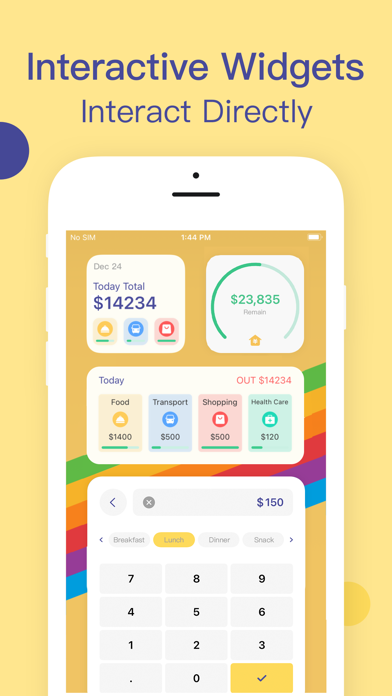


InnerGrow's Budget App takes the opposite philosophy from minimalist trackers: it bundles budget planning, spending tracking, subscription management, shared ledgers, AI receipt scanning, voice input, widgets, and Shortcuts support under one icon. At 230 MB it is the heaviest app in its class, but that bulk buys genuine breadth. A 4.72 average rating across 15K reviews signals the kitchen-sink approach resonates strongly with users who prefer depth over simplicity.
Comprehensive toolkit actually delivers on its promises
The feature list is long and, refreshingly, mostly substantive. Users can budget by category and sub-category on weekly, monthly, or fully custom cycles, manage debit, credit, and investment accounts side by side, and automate recurring transactions. AI-assisted receipt scanning and voice input meaningfully reduce manual data entry, while a calendar view transforms daily spending patterns into something immediately readable. Shared ledgers extend the app to couples or households. The toolkit is genuinely comprehensive rather than padded, and the 4.72 rating across 15K users suggests most people find that the features actually work as advertised rather than existing as marketing checkboxes.
Mature development supports reliable daily use
Qualitative signals point toward solid everyday reliability. The app has been updated as recently as July 2026, version 1.5.41 represents mature, iterative development since its August 2020 launch, and a 15K rating pool large enough to surface real-world friction still yields a 4.72 average. The 230 MB install size is notable and reflects the AI scanning engine plus widget layers bundled inside. That footprint is worth acknowledging on devices with limited storage, though it should not cause slowdowns on any current iPhone. Widgets and Shortcuts integration add genuine utility for users who want quick glances or automated logging without opening the app each time.
Free with no ads or data sales
The app is free with no in-app advertisements, which is a meaningful distinction in a finance category where free apps frequently monetize through data partnerships or aggressive upsell prompts. InnerGrow's stated stance is that it neither sells data nor runs ads, so the zero-dollar price tag appears to be the actual price. Whether a premium tier or optional subscription exists for advanced features is worth verifying on the App Store listing, but the core toolkit is available without payment. For users who would otherwise pay for separate budgeting, receipt-scanning, and subscription-tracking apps, the value proposition is strong.
Review privacy label before entering financial data
InnerGrow publicly positions the app as free of data harvesting, a notable commitment in a category where transaction histories are commercially valuable. That said, the definitive source for what data is collected, linked to your identity, or used for tracking is the App Store privacy nutrition label on the app's official listing. Prospective users should review that label directly before entering financial information. Permissions to watch for in any budgeting app include camera access for receipt scanning, microphone access for voice input, and any network permissions tied to cloud sync. All three are functional requirements here rather than red flags, but reviewing them in iOS Settings after install is good practice.
Feature density creates learning curve despite clean design
The interface carries the weight of its feature set reasonably well, though first-time users will encounter a learning curve that a single-purpose tracker avoids entirely. Navigation across budgets, accounts, subscriptions, and shared ledgers requires some orientation. The calendar view and widget support show genuine design consideration for at-a-glance use rather than burying everything in menus. On accessibility, the app carries a 4+ content rating and targets standard iOS conventions, meaning Dynamic Type and VoiceOver compatibility should follow platform norms, though users with specific accessibility requirements should verify behavior firsthand. The overall aesthetic is clean enough to avoid feeling cluttered despite the feature density.
Active development continues through regular updates
Maintenance signals are genuinely strong. A July 2026 update to version 1.5.41 confirms the development team is actively iterating, and the version number itself reflects years of incremental refinement since the August 2020 launch. Sustained engagement across 15K ratings without a meaningful drop in average score suggests the team has kept pace with iOS updates and user feedback rather than allowing the app to stagnate. For a free, ad-free tool, that level of ongoing investment is worth noting, as finance apps that lose maintenance quickly become liabilities rather than assets.
Pros
- Genuinely comprehensive feature set covering budgets, subscriptions, shared ledgers, and AI receipt scanning
- Free with no ads and no stated data selling, a rare combination in personal finance
- Actively maintained with a July 2026 update reflecting years of iterative development
- Widget and Shortcuts integration enable quick access without opening the full app
Cons
- 230 MB install size is the heaviest in its class and demands meaningful device storage
- Feature density creates a real learning curve that casual or first-time budgeters may find off-putting
- Users must verify the App Store privacy label independently since no third-party audit data is available
Related guides
Similar Finance apps


apptidal is independent and ad-supported. We earn no commission on installs and no company can pay for a better score. How we stay independent.