
Finance · iOS
Money Tracker & Saver
by New Waving

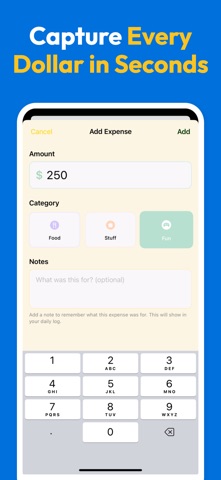
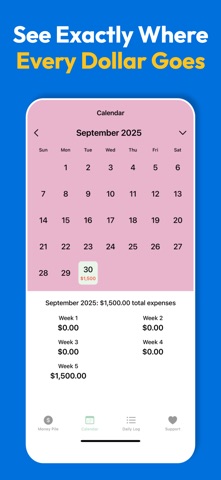
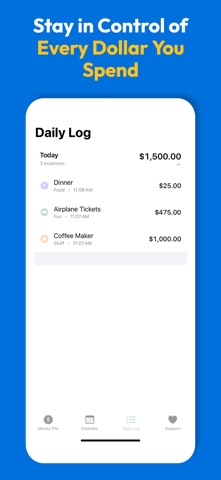
Released in October 2025 by New Waving, this free iOS app targets personal finance newcomers with category budgets, receipt-attached expense logging, multi-source income tracking, and a no-spend challenge streak. At 16 MB it is light on storage, and the price of entry is zero. What it cannot yet offer is any verified real-world performance, user feedback, or transparency around what in-app purchases might eventually cost.
Sensible core features lack user verification
The core loop is sensible for a beginner-oriented tool: assign spending limits to custom categories such as groceries or utilities, log transactions against those limits in real time, and attach receipt photos so nothing slips through the cracks. Multi-source income tracking adds practical value for freelancers or gig workers managing several revenue streams at once. The no-spend challenge is the most distinctive element, giving users a visible streak to protect rather than a passive graph to ignore. That behavioral nudge separates the app slightly from a plain ledger. Whether all of these features work as advertised, however, is genuinely unknown. Zero ratings and a version 1.0 label mean every claim on the store page remains unverified by actual user experience.
Compact size masks unknown stability
Without any user reviews or update history to draw from, performance can only be assessed through indirect signals. The 16 MB install size is compact even by finance-app standards, suggesting a lightweight codebase that should load quickly on most devices, including older hardware. That said, a small footprint can also reflect a limited feature set or stripped-back processing rather than engineering efficiency. The app launched and was last updated on the same date, October 1, 2025, meaning no post-launch patches have been issued yet. Crash behavior, sync reliability, and receipt-capture accuracy under real conditions are all unknowns. Qualitatively, version 1.0 finance apps tend to carry more rough edges than equivalent apps in lower-stakes categories.
Free entry point obscures true cost
The download is free, which lowers the barrier to trying it. The problem is that in-app purchase details are not disclosed in the store listing, so the true ceiling of what full functionality might cost remains opaque. For a casual game that ambiguity is a minor annoyance; for an app meant to track real money, it is a meaningful gap. Competing free finance apps such as Spendee or Wallet have established feature sets, years of user reviews, and clearer pricing tiers. Until Money Tracker and Saver clarifies its monetization structure and accumulates honest user feedback, the value proposition is essentially a gamble on an unproven product.
Privacy practices require independent verification
Finance apps routinely request sensitive permissions, potentially including camera access for receipt capture and storage access for local data. The actual permissions this app requests at runtime are not something we can verify independently. Prospective users should consult the App Store privacy nutrition label on the app's product page before installing, as that label is the authoritative source for what data is collected, how it is used, and whether it is linked to your identity. New Waving is a developer with no established public privacy reputation, which makes that label check more important here than it would be for a well-known publisher. The content rating of 4-plus indicates no flagged content, but that tells us nothing about data practices.
Interface accessibility cannot be confirmed
No screenshots or third-party walkthroughs are available to assess the interface in depth at this stage. The feature framing, category budgets, receipt attachment, streak-based challenges, suggests a card-or-list layout common in the personal finance genre, which tends to be navigable for beginners. Accessibility support, including VoiceOver compatibility, dynamic type scaling, and sufficient color contrast, cannot be confirmed from available data. Apple's App Store review process requires basic accessibility compliance, so a minimum baseline is likely present, but finance apps vary widely in how thoughtfully those standards are implemented beyond the minimum. Users who rely on assistive technologies should test the app personally before committing to it as a daily tool.
No updates since launch signal risk
The release date and the last-updated date are identical, which means no maintenance activity has occurred since launch. That is not unusual in the first days of a new release, but it leaves no signal about how responsive New Waving will be to bug reports, feature requests, or compatibility updates as iOS evolves. A finance app that goes unmaintained quickly becomes a liability: data formats change, OS updates break integrations, and security vulnerabilities go unpatched. The single version number, 1.0, reinforces that this is a product at the very start of its lifecycle. Revisiting after two or three update cycles and a meaningful volume of user reviews would give a far clearer picture of whether the developer is genuinely committed to the app.
Pros
- No-spend challenge streak adds a behavioral motivation layer most basic budget apps skip
- Receipt photo attachment produces more complete expense records than memo-only logging
- Multi-income source tracking is a practical feature for freelancers and side-hustle earners
- Compact 16 MB install is friendly to older or low-storage devices
Cons
- Zero ratings and a single version mean no real-world validation of any feature claim
- In-app purchase scope is undisclosed, leaving the true long-term cost unknown
- No update history and no post-launch patches make ongoing maintenance commitment impossible to judge
Related guides
Similar Finance apps


apptidal is independent and ad-supported. We earn no commission on installs and no company can pay for a better score. How we stay independent.