
Finance · iOS
Spending Tracker-Money Manager
by MISA JSC

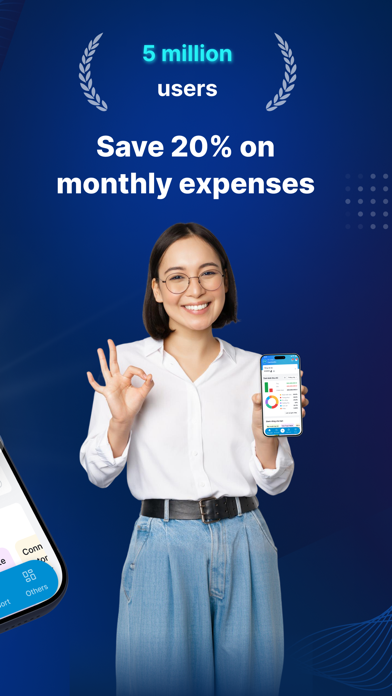


Released in 2014 and still receiving updates as recently as June 2026, Spending Tracker by MISA JSC has accumulated over 5 million users and a 4.67 store rating. The app targets individuals and families seeking a low-friction daily logging habit, offering voice entry, AI invoice scanning, and automatic bank sync as its three core input methods. At 202 MB, the install is substantial, but the feature density justifies the footprint for anyone serious about consistent budgeting.
Three input methods reduce logging friction
The central pitch is reducing the friction of expense logging through three distinct input methods. Voice entry handles a quick coffee purchase in seconds, AI-powered invoice scanning offloads categorization to the app rather than the user, and bank sync passively captures recurring transactions in the background. Together, these options address the most common reason people abandon trackers: manual entry fatigue. Per-category budget alerts add a second layer of utility, moving the app beyond simple logging into genuine spending awareness. For users who know they overspend but cannot identify where, that combination of automated capture and category-level feedback is a meaningful practical step forward over basic manual loggers.
Polished experience with active update cycles
Qualitative signals suggest a reasonably polished experience. A 4.67 average rating, even from a modest 841 reviews, indicates that the users who do leave feedback are largely satisfied. The 202 MB install size is heavier than comparable single-purpose finance utilities, which may reflect a richer feature set or accumulated assets from a decade of development. Version 90.3 points to a rapid release cadence, which typically means active bug fixing but can also introduce short-lived regressions after updates. Bank sync performance, a feature especially sensitive to real-world reliability, will vary depending on which financial institutions are supported in a given region, so users outside major markets should verify compatibility before committing.
Free tier scope requires verification
The app is free to download, which lowers the barrier to trying it. The concern is that the scope of in-app purchases is not clearly disclosed upfront in the store listing. Core features like voice entry and AI scanning may sit partially or fully behind a subscription, and discovering that after building a logging habit is genuinely disruptive. Solo users with a single bank account may find the full feature set excessive and the free tier sufficient. Households juggling multiple accounts will likely extract the most value, but they are also the users most likely to hit premium paywalls. Auditing what the free tier actually covers during the first session is strongly advised.
Bank sync and scanning demand privacy review
A finance app that connects to bank accounts, processes voice input, and scans receipt images touches several sensitive data categories simultaneously. We cannot independently verify what data is collected, retained, or shared, and we have not fabricated any privacy-label findings here. The correct approach is to open the App Store listing directly, scroll to the App Privacy section, and review the declared data types under "Data Used to Track You" and "Data Linked to You." Given that bank sync and AI scanning both require transmitting financial information to external servers, users should also review MISA JSC's privacy policy for details on data retention periods and third-party sharing practices before enabling those features.
Design prioritizes effort reduction over features
The multi-mode entry system, combining voice, scanning, and sync, suggests a design philosophy oriented toward reducing user effort, which generally correlates with cleaner interface decisions. A content rating of 4+ indicates no mature content concerns. Formal accessibility outcomes such as VoiceOver compatibility or Dynamic Type support are not independently verifiable from store data alone, but users who rely on assistive technologies should test the core logging flow early. Finance apps with heavy visual charting can sometimes underserve screen-reader users if chart data is not exposed as text. The long development history since 2014 does suggest iterative UI refinement over time, which typically benefits usability broadly.
Twelve years of continuous development
By any reasonable measure, yes. A release date of April 2014 combined with a last update of June 2026 represents over twelve years of continuous development, which is rare and reassuring for an app handling sensitive financial data. Version 90.3 confirms a high-frequency update cadence rather than occasional maintenance releases. For a finance utility, active maintenance matters beyond feature additions: it signals that security patches and API updates for bank connections are being addressed on a regular cycle. The relatively low review count of 841 against a claimed 5 million user base is worth noting, as it limits the statistical confidence of the 4.67 rating, but the development track record itself is a strong independent signal of commitment.
Pros
- Three distinct entry methods, voice, AI scanning, and bank sync, meaningfully lower the daily logging barrier
- Per-category budget alerts move the app beyond passive tracking into actionable spending awareness
- Over twelve years of continuous development with a June 2026 update signals reliable long-term maintenance
- A 4.67 rating across 841 reviews suggests strong satisfaction among users who engage enough to leave feedback
Cons
- The scope of in-app purchases is not clearly disclosed upfront, creating paywall risk after habit formation
- At 202 MB, the install footprint is notably heavier than comparable single-purpose finance utilities
- Bank sync availability and reliability will vary significantly by region and supported institution
Related guides
Similar Finance apps


apptidal is independent and ad-supported. We earn no commission on installs and no company can pay for a better score. How we stay independent.