
Finance · iOS
Track Spending : Wise Budget
by Marwan Ghafoor
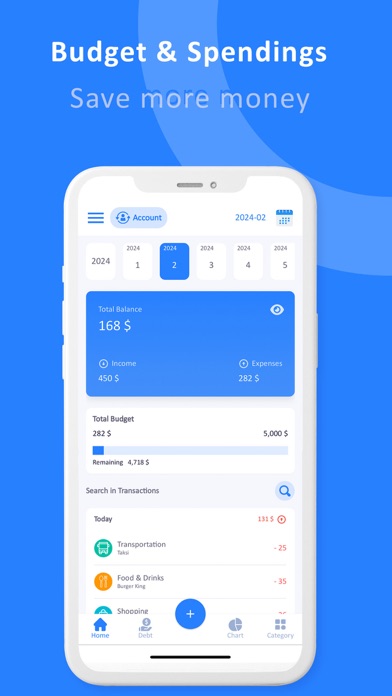


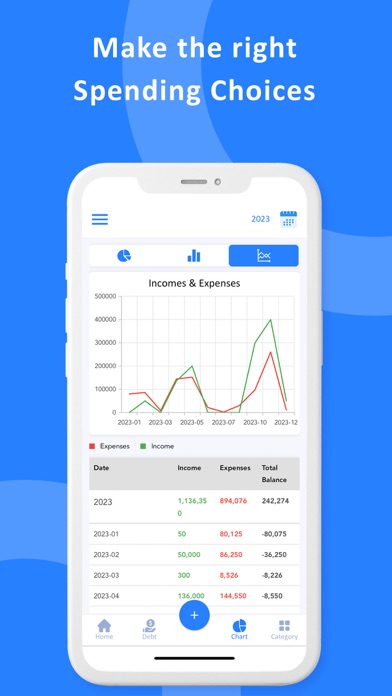
Released in December 2022 and updated as recently as May 2026, Track Spending : Wise Budget is a solo-developer personal finance app for iOS. It focuses on deliberate, manual logging of income and expenses across fully customizable categories. Nearly 3,000 ratings averaging 4.78 stars reflect a genuinely satisfied early audience, though that sample size is modest enough to recommend a trial period before relying on it as a primary financial tool.
Custom categories elevate basic expense tracking
The core function is straightforward daily tracking of income and expenses, with the standout feature being fully user-defined spending categories. Rather than locking users into presets like 'Dining' or 'Transport,' the app lets you name and shape categories around your actual life, whether that means tracking a niche hobby, irregular freelance income, or split household costs. That flexibility is genuinely rare at the free tier and is almost certainly the reason the rating climbs as high as it does. The app appears to be a manual-entry tool rather than a bank-syncing platform, which suits a deliberate, mindfulness-oriented budgeting style but limits automated utility for users expecting connected accounts.
High ratings suggest stable daily performance
Qualitative signals here are reasonably encouraging. A 4.78 average across close to 3,000 ratings suggests that crashes, data-loss bugs, and major UI frustrations are not widespread complaints. The 99 MB install size is notably heavy for a manual budget tracker, a category where lean competitors often sit under 30 MB, which raises fair questions about asset bloat or bundled frameworks. That said, size alone does not confirm sluggishness. Update recency is a stronger positive signal: version 5.3.4 shipped in May 2026, indicating the developer is actively addressing issues rather than leaving the codebase to stagnate. Performance on older or lower-storage devices is worth testing during any trial period.
Free tier scope requires direct verification
The app is free to download, which removes any upfront risk. The friction point is that in-app purchase details are not clearly disclosed in public-facing materials, so it is genuinely unclear whether core features like data export, recurring entries, or multi-currency support sit behind a paywall. That ambiguity is a real problem when comparing it against transparent competitors. Before committing to regular use, we recommend opening the app and reviewing the purchase screen directly to understand exactly what the free tier covers long-term. If the paid tier is reasonably priced and clearly scoped, the overall value proposition could be strong given the active maintenance history.
Privacy practices need App Store label review
We cannot responsibly characterize the app's specific data practices without fabricating findings. The authoritative source for this is the App Store privacy label on the app's product page, which Apple requires developers to complete and which lists data types collected, whether data is linked to your identity, and whether it is used for tracking. For a finance app, the most important things to verify there are whether transaction data leaves the device, whether any analytics or advertising SDKs are bundled, and what permissions the app requests at install. Given the 99 MB size, checking for third-party SDK presence via the privacy label is especially worthwhile.
Intuitive design undermined by unknown accessibility support
A content rating of 9-plus and a finance category context suggest the interface is designed for general adult audiences rather than specialized users. The high rating implies the core navigation is intuitive enough that most users do not abandon it quickly. Custom category creation, when implemented well, also tends to signal thoughtful UX decision-making. Formal accessibility details, such as VoiceOver compatibility, Dynamic Type support, and sufficient color contrast, are not verifiable without hands-on testing. Users who rely on assistive technologies should run a short trial specifically testing those features before depending on the app for regular financial tracking.
Three years of consistent updates signal commitment
Maintenance is one of this app's clearest strengths. Launched in December 2022 and now at version 5.3.4 with an update logged in May 2026, the development timeline shows consistent iteration over roughly three and a half years. That cadence matters in the finance category, where iOS updates, new device sizes, and changing App Store requirements can quickly break neglected apps. Solo-developer projects carry an inherent continuity risk compared to funded teams, but the evidence here points to an engaged developer rather than an abandoned project. Version numbering in the mid-5 range also suggests meaningful feature evolution beyond the initial release.
Pros
- Fully customizable spending categories accommodate non-standard financial lifestyles
- Free entry point with no upfront cost lowers the barrier to a genuine trial
- Consistently updated since 2022, with version 5.3.4 shipping as recently as May 2026
- 4.78-star average across nearly 3,000 ratings signals broad user satisfaction with core functionality
Cons
- In-app purchase scope is not clearly disclosed, making long-term cost assessment difficult
- 99 MB install size is significantly heavier than most comparable manual budget trackers
- No confirmed support for bank or account syncing limits utility for users wanting automated imports
Related guides
Similar Finance apps


apptidal is independent and ad-supported. We earn no commission on installs and no company can pay for a better score. How we stay independent.