
Tools · iOS
Habit Tracker - Daily Goals
by Uniqo Lab.
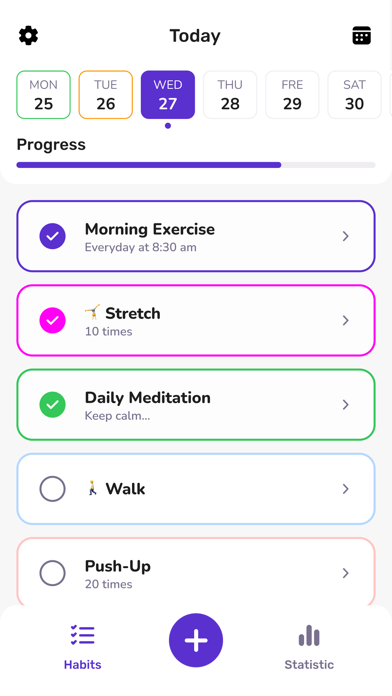


Released in June 2024 and already updated through May 2026, Habit Tracker - Daily Goals from Uniqo Lab. covers both habit-building and habit-breaking with volume logging, multiple reminders, and weekly through yearly reports. At 35 MB the install stays lean. A 4.85 store rating across roughly 3,000 reviews signals early user satisfaction, and the absence of ads or mandatory subscriptions makes that enthusiasm easier to understand.
Unit logging and reports elevate beyond checkmarks
The defining mechanical choice is unit-based goal tracking. Rather than a binary done-or-not tap, users log actual volume and attach custom units, so a water intake habit or a weekly running goal carries real numbers rather than empty checkmarks. That analytical layer, combined with multiple reminders per habit and report breakdowns spanning weekly, monthly, and yearly views, pushes the app noticeably beyond motivational-poster territory. A built-in habit ideas library lowers the barrier for newcomers who are unsure where to start. The dual-mode system, supporting both building positive habits and breaking negative ones, broadens practical utility compared with single-mode trackers. For version 1.1.0, the core feature set is coherent and well-executed, even if the edges are still being filled in.
Compact size and recent updates signal active development
A 35 MB install size is genuinely compact for a modern iOS utility, suggesting the developer has avoided asset bloat that slows launch times on older devices. Update recency is a strong positive signal here: a May 2026 update on an app released in mid-2024 indicates active iteration rather than an abandoned side project. The 4.85 rating across around 3,000 reviews is high, though that review volume is modest by category standards, so it reflects an enthusiastic early adopter base more than a broad stress test. Daily logging workflows built around unit entry and reminder scheduling should feel fluid on current iOS hardware, but users on older devices or with very large habit libraries may want to monitor performance as their data grows.
Free model without subscriptions stands apart
The app is free to download, and the developer explicitly positions it without mandatory subscriptions or ads, which is a meaningful differentiator in a category where competitors routinely charge five to ten dollars per month for comparable features. The uncertainty worth noting is that in-app purchase details are not clearly documented in public-facing materials, so the exact boundaries of the free tier remain somewhat opaque. Users should review the App Store listing carefully before assuming every feature is permanently unlocked. Even if a one-time unlock purchase exists, the baseline offering appears generous. For anyone experiencing subscription fatigue, the pricing model alone justifies a download and a genuine evaluation.
Privacy practices require direct App Store review
Uniqo Lab. has not been the subject of notable public privacy controversies, but that is not a substitute for reading the actual data practices. The App Store privacy label for this app is the authoritative source on what data is collected, whether it is linked to your identity, and whether it is used for tracking. Habit data is inherently personal, capturing daily routines and health-adjacent behaviors, so reviewing those disclosures before logging sensitive goals is worthwhile. Notification permissions will be requested to support the multiple-reminder feature. We recommend checking whether any analytics or crash-reporting frameworks are included, as these are common in free apps even when ads are absent.
Interface prioritizes usability over complexity
The 4+ content rating and the clean, goal-oriented framing suggest an interface aimed at broad usability rather than power-user density. Unit-based logging requires slightly more interaction than a single tap, but the added friction is purposeful and unlikely to feel burdensome. Accessibility specifics such as Dynamic Type support, VoiceOver compatibility, and color contrast compliance are not independently verifiable without hands-on testing, but iOS apps following Apple's Human Interface Guidelines generally inherit a reasonable accessibility baseline. Users with specific accessibility needs should test the logging and reporting screens directly, as data-entry interfaces vary considerably in screen-reader friendliness across this category.
Early version leaves room for standard features
The update history is encouraging for an app less than two years old. Moving from launch to a May 2026 update with version 1.1.0 still in place suggests the developer is refining existing functionality rather than chasing version-number inflation. That said, 1.1.0 is an early designation, and features that mature habit trackers have offered for years, such as home-screen widgets, Apple Health integration, and calendar sync, are not confirmed as present. The 3,000-rating count is growing but still relatively small, which means community-driven bug reports and feature requests have had less time to shape the roadmap. Continued active maintenance is the single biggest variable in whether this app fulfills its early promise.
Pros
- Genuinely free with no ads and no mandatory subscription, a rare combination in this category
- Unit-based volume logging moves beyond checkboxes for goals like hydration or exercise distance
- Multiple reminders per habit allow flexible, personalized scheduling throughout the day
- Weekly, monthly, and yearly reports provide a meaningful long-term perspective on progress
Cons
- In-app purchase scope is poorly documented, leaving free-tier limits unclear before download
- Version 1.1.0 is early and likely lacks mature integrations such as widgets or Apple Health
- A review base of roughly 3,000 ratings is too small to fully validate long-term stability
Related guides
Similar Tools apps


apptidal is independent and ad-supported. We earn no commission on installs and no company can pay for a better score. How we stay independent.