
Finance · iOS
PocketGuard・Budget Planner App
by PocketGuard, Inc.
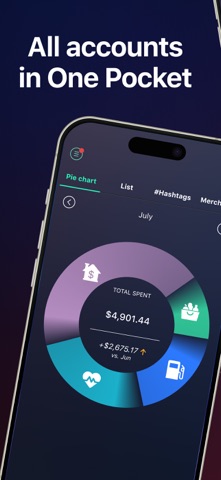


Active since January 2015 and still receiving updates as recently as June 2026, PocketGuard has spent a decade refining a straightforward premise: surface one actionable number, called Leftover, that reflects what you can genuinely spend after bills, savings goals, and essentials are covered. At 150 MB it is a heavier install than many finance utilities, yet for users who want a low-friction financial snapshot rather than a manual ledger, it earns a consistent spot on the home screen.
Leftover-focused design trades simplicity for power
Rather than burying users in category breakdowns, PocketGuard centers its interface on a single figure, the Leftover number, representing disposable income after obligations are automatically accounted for. Bill monitoring and expense tracking run in the background, so you are not manually tagging every purchase to get a useful answer. This design philosophy turns the app into a financial dashboard rather than a budgeting worksheet, and it executes that vision with genuine clarity. The tradeoff is intentional simplification: power planners who want granular category control or detailed historical reporting will find the feature set deliberately constrained. For the audience PocketGuard is targeting, casual spenders who want automation over configuration, the core functionality holds up well after a decade of refinement.
Solid ratings mask some connectivity friction
A 4.58 rating drawn from roughly 8,000 reviews points to broadly positive day-to-day experience, though that score is solid rather than exceptional, suggesting a meaningful minority of users encounter friction. The 150 MB install size is notably heavier than comparable finance apps in the category, which may reflect the breadth of bank-sync integrations bundled inside. Update cadence is a genuine strength: version 5.19.5 landed in June 2026, indicating the team is actively addressing bugs and compatibility rather than coasting. Performance in practice will depend heavily on how reliably your specific bank connection syncs, a variable no review can fully predict, but the active maintenance cycle at least suggests connectivity issues are being worked on continuously.
Free tier requires scrutiny before bank linking
The app is free to download, but the freemium structure deserves careful scrutiny before you link your bank accounts. Core features like the Leftover snapshot may be accessible without paying, yet more advanced capabilities, such as unlimited budgets, debt payoff planning, or custom categories, are reported to sit behind a PocketGuard Plus or annual subscription. Prospective users should walk through the free tier thoroughly before committing personal financial data, because the value calculation changes substantially depending on which features you actually need. Compared to YNAB at a higher annual price, PocketGuard can represent genuine savings for users whose needs stay within the free or lower-cost tier.
Bank connection raises privacy stakes significantly
Because PocketGuard connects directly to bank and credit accounts, the privacy stakes are meaningfully higher than for a typical utility app. We did not independently audit network traffic or data handling, and fabricating findings would be irresponsible. The right move is to review the app's privacy nutrition label directly on the App Store listing, which details what data is collected, whether it is linked to your identity, and how it is used. Pay particular attention to categories like financial information and usage data. Additionally, review PocketGuard's published privacy policy for details on third-party data sharing, especially with the aggregators that power bank-sync functionality. The content rating of 4-plus reflects no objectionable content, not a security assessment.
Minimal interface prioritizes clarity over options
The interface is built around reducing cognitive load, and that priority is visible in the layout. A prominent Leftover figure, clean typography, and a minimal navigation structure all suggest deliberate design restraint rather than feature-cramming. The 4-plus content rating confirms the experience is broadly appropriate. On accessibility, the app follows iOS conventions, which means VoiceOver and Dynamic Type support are plausible given Apple's developer guidelines, though we cannot verify screen-reader behavior without hands-on testing. Users with accessibility requirements are best served by downloading the free version and testing core flows with their preferred assistive technology before committing to a subscription tier.
Decade of active development through mid-2026
Maintenance is one of PocketGuard's clearest strengths. Launched in January 2015, the app has reached version 5.19.5 with an update logged in June 2026, meaning it has been actively developed for over a decade without going dormant. That update recency matters practically: financial apps depend on live bank connections and must stay current with iOS changes, and a team pushing releases into mid-2026 is demonstrably doing that work. The 8,000-plus review count also provides a large enough feedback pool to surface recurring bugs, giving the developer meaningful signal to act on. For a category where abandoned apps can leave sensitive account links orphaned, this kind of sustained commitment is worth noting explicitly.
Pros
- Leftover feature delivers a clear, actionable safe-to-spend figure without requiring manual data entry
- Consistently active development, with updates running through mid-2026 across more than a decade of releases
- Low conceptual barrier makes it genuinely approachable for first-time budgeters
- Automatic bill monitoring and expense tracking reduce the ongoing effort most budgeting apps demand
Cons
- Freemium structure creates real uncertainty about which features require a paid subscription before you commit your bank credentials
- 150 MB install footprint is bulkier than most comparable finance utilities on the App Store
- Simplification-first design deliberately limits granular category control, making it a poor fit for detail-oriented budgeters
Related guides
Similar Finance apps


apptidal is independent and ad-supported. We earn no commission on installs and no company can pay for a better score. How we stay independent.