
Finance · iOS
Subscription Tracker
by Ali Alhady
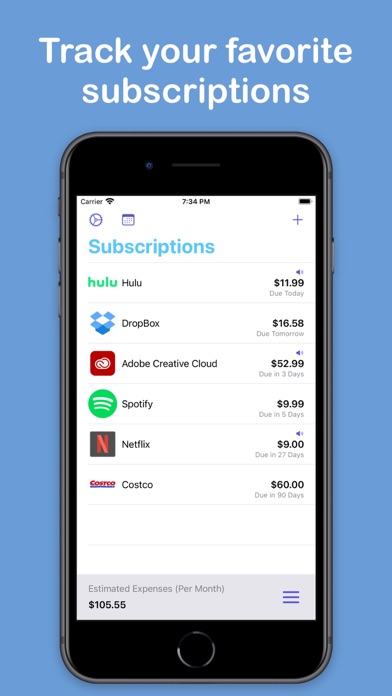
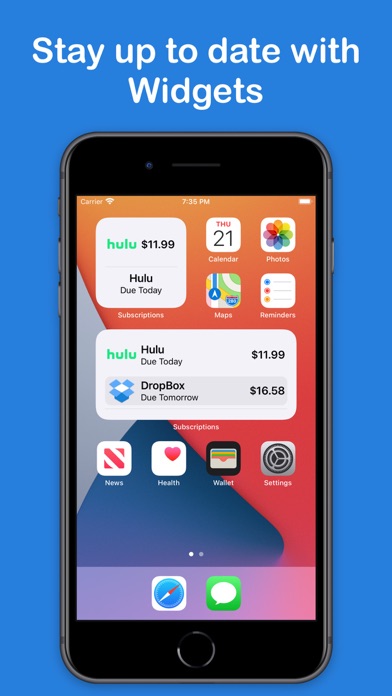
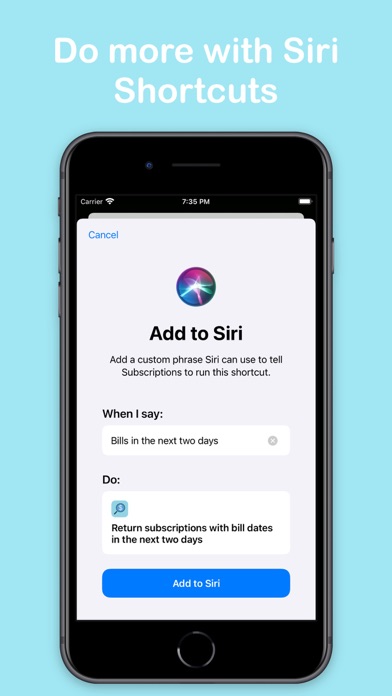
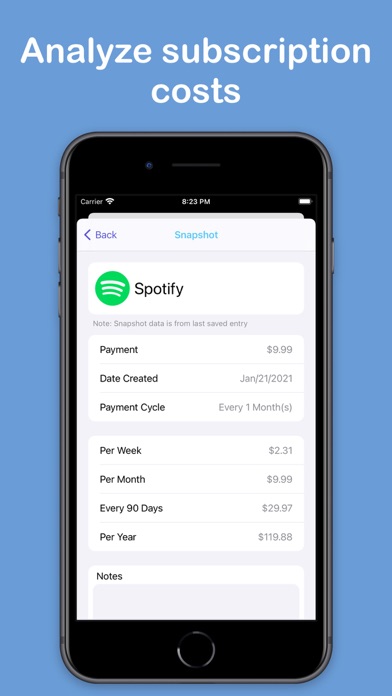
Built by solo developer Ali Alhady and released in March 2020, Subscription Tracker is a lean 10 MB finance app that lives entirely on your device. No account creation, no server uploads, just a local record of your recurring bills. Across 254 App Store reviews it holds a 4.62 rating, which signals real user satisfaction. The pitch is straightforward: see what you pay, when you pay it, and what that adds up to annually.
Manual entry delivers honest subscription totals
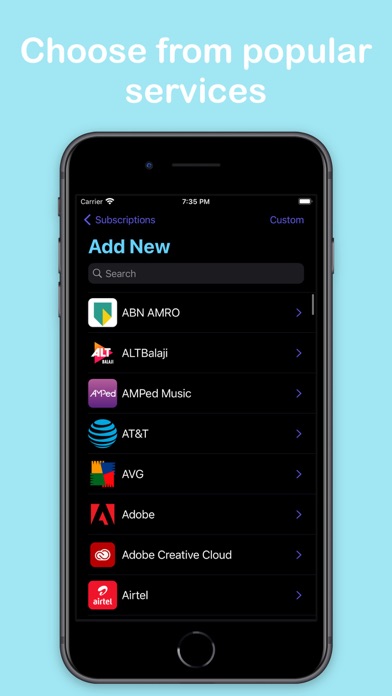
The core loop is manual entry: pick a service from a library of popular icons or create a custom entry with a name, amount, billing frequency, and icon. From there the app calculates cost breakdowns across daily, weekly, monthly, and yearly averages, giving an honest picture of how small recurring charges compound over time. A calendar view maps upcoming billing dates visually, and opt-in push notifications can flag a charge before it hits your account. Everything stays on the device, which is either a meaningful privacy feature or a real limitation depending on how many phones you use. Within its narrow scope the app delivers reliably, and the rating data backs that up.
Lightweight build runs smoothly on modern iPhones
A 10 MB install size suggests a native, lightweight build with minimal overhead, and nothing in the rating history points to widespread crash complaints. Launch times and navigation should feel snappy on any modern iPhone. The app carries a 4+ content rating and requires no background network activity for its core function, so battery and data impact should be negligible. That said, qualitative performance impressions are hard to separate from the maintenance question: an app last updated in October 2022 has not been tested against the most recent iOS releases, and subtle compatibility issues can surface silently without user-facing crash reports.
Free download with unclear premium features
The base download is free, which removes any barrier to trying it. The app is listed with in-app purchases, though the specifics of what those unlock are not disclosed in the available store data. Prospective users should check the App Store listing directly before downloading to understand whether core features sit behind a paywall. Taken at face value as a free utility, the value proposition is solid for anyone who simply wants a running total of their subscriptions. More capable alternatives with sync, automatic transaction import, or active development may justify a small subscription fee if long-term reliability matters more than simplicity.
Offline design eliminates data collection concerns
The fully offline, no-account design is the strongest privacy argument this app can make. No email address, no cloud account, and no stated data collection are meaningful differentiators in a finance category where many competitors require sign-up. That said, we cannot independently verify what permissions the app requests at runtime or what the App Store privacy nutrition label currently shows. Before installing, tap the Privacy section on the App Store product page to review declared data types. The 4+ content rating and the absence of any login flow are positive signals, but the privacy label is the authoritative source and worth a few seconds of review.
Simple two-view interface prioritizes ease of use
The interface centers on two primary views, a cost summary and a billing calendar, which keeps the learning curve minimal. Icon support for popular services adds visual clarity and speeds up entry. The design language appears to follow iOS conventions, which generally means baseline VoiceOver compatibility and Dynamic Type support come along for free, though we cannot confirm specific accessibility test results. Users who rely on assistive technologies should verify screen-reader behavior after installing. Overall the app prioritizes simplicity over feature density, and for its target audience that restraint reads as good design rather than a shortcut.
No updates since October 2022 raise compatibility questions
This is the sharpest concern with Subscription Tracker. Version 1.4.5 was released on October 3, 2022, meaning the app has gone without a public update for well over two years at the time of this review. In a finance category where streaming prices shift frequently and new services appear constantly, a stale icon library and preset service data are predictable side effects. More critically, iOS evolves annually, and an app that has not been resubmitted risks quiet compatibility gaps. The 254 reviews and 4.62 rating reflect historical satisfaction, but they do not guarantee the app is being actively watched or that a fix would arrive quickly if something broke.
Pros
- Fully offline and on-device with no login or account required, a genuine privacy advantage
- Calendar view gives a clear, at-a-glance picture of upcoming billing dates
- Cost averaging across daily, weekly, monthly, and yearly periods is practically useful
- Tiny 10 MB footprint with a strong 4.62 store rating across 254 reviews
Cons
- No update since October 2022 raises real questions about iOS compatibility and long-term support
- No iCloud or cross-device sync means all data is stranded on a single phone
- Fully manual entry with no bank or card import, and in-app purchase details are not clearly disclosed
Related guides
Similar Finance apps


apptidal is independent and ad-supported. We earn no commission on installs and no company can pay for a better score. How we stay independent.